Chi3 Optics

Boulder, Colorado

It all starts with
the light source.

Turnkey fiber frequency combs, dual-comb spectrometers, ultrafast lasers and amplifiers — nonlinear by design, coherent by requirement, and proven in the field on the path from fiber to chip.

Products

Combs, lasers and amplifiers

Every system ships with servo inputs, a factory test report and direct access to the engineers who built it. Compact, turnkey and built for high-precision measurement — in the lab or in the field.
Juniper
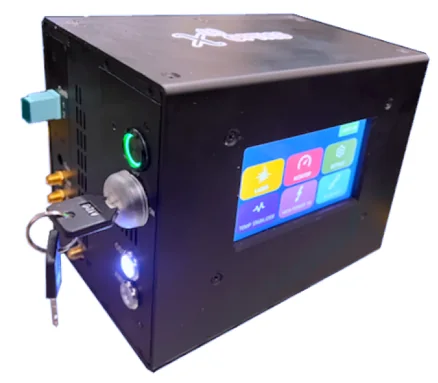
Frequency comb

Juniper

Compact, turnkey optical frequency comb
  • >150 mWcomb output
  • 1 – 2 µmSC extension
  • < 300 mradfceo phase noise
View product →
Juniper OSO
Frequency comb

Juniper OSO

Offset-stabilized fiber frequency comb, made simple
  • <1.5 Welectrical power
  • 100 MHzrepetition rate
  • 9.7×10⁻¹⁷fceo ADEV at 1 s
View product →
Aspen
Frequency comb

Aspen

Two-color 1 / 1.5 µm frequency comb

  • 1040 + 1560 nmcoherent outputs
  • >200 mWat 1 µm
  • ~100 fscompressed
View product →
Saguaro
Dual-comb

Saguaro

Compact dual frequency comb system

  • 2 ×matched combs
  • 120 mWper output (std.)
  • 20 – 250 MHzrep. rate options
View product →
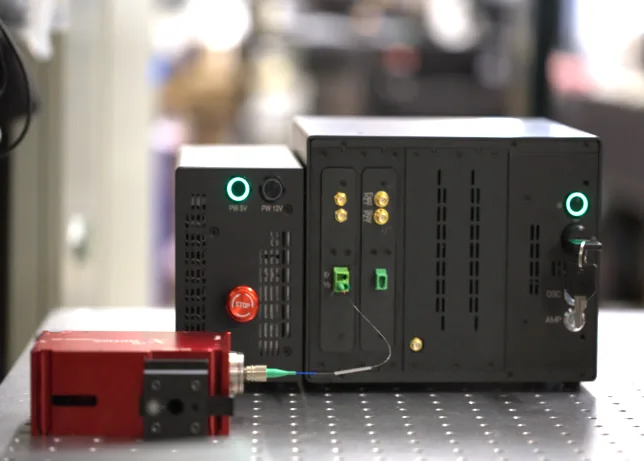
Saguaro-MIR
Dual-comb

Saguaro-MIR

Fully packaged 3–5 µm mid-IR dual-comb spectrometer
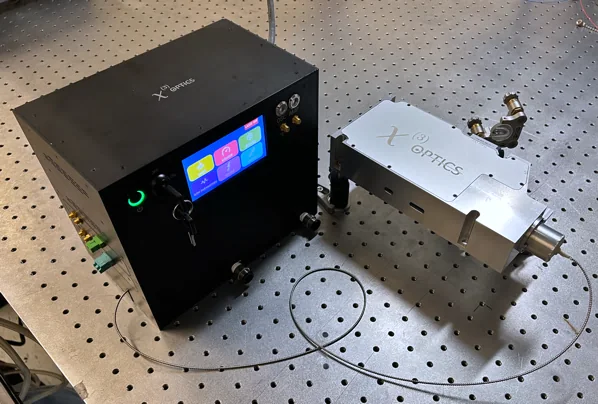
  • 3 – 5 µmmid-IR coverage
  • Open-pathfield-tested
  • Onboardf–2f & servos
View product →
Sequoia
High-power comb

Sequoia

CEP-stable high-power ultrafast laser
  • 3 Waverage power
  • Full FSRfceo locking range
  • < 250 mradfopt phase noise
View product →
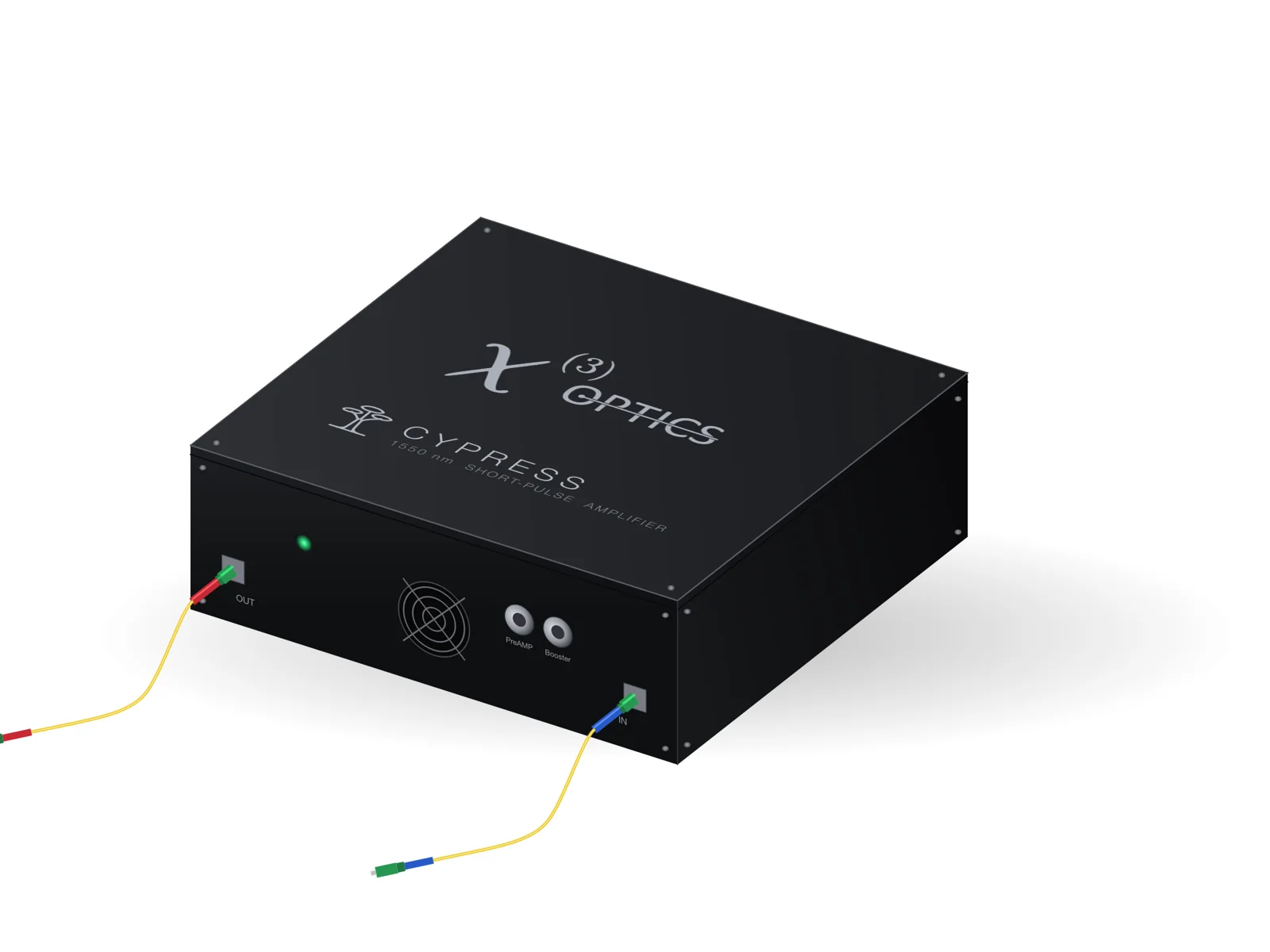
Cypress
Amplifier

Cypress

All-fiber short-pulse amplifier for high-repetition-rate lasers

Cypress is a dispersion-compensated amplifier for high-repetition-rate 1550 nm pulsed lasers such as GHz mode-locked oscillators. It employs chirped-pulse amplification and precise nonlinear compression to deliver short pulses directly out of fiber — ideal for supercontinuum generation and mid-infrared generation through intrapulse difference-frequency generation (IP-DFG). A custom HNLF patch cable can be shipped with the system for clean, tailored supercontinuum generation. The name comes from the Formosa cypress (Taiwan red cypress), the giant of Taiwan's mountain forests whose ancient trees are among the largest in Asia.

  • > 1.5 Woutput power
  • < 70 fsout of fiber
  • 1 GHznominal rep. rate
View product →

Out of the lab

Field-proven frequency combs

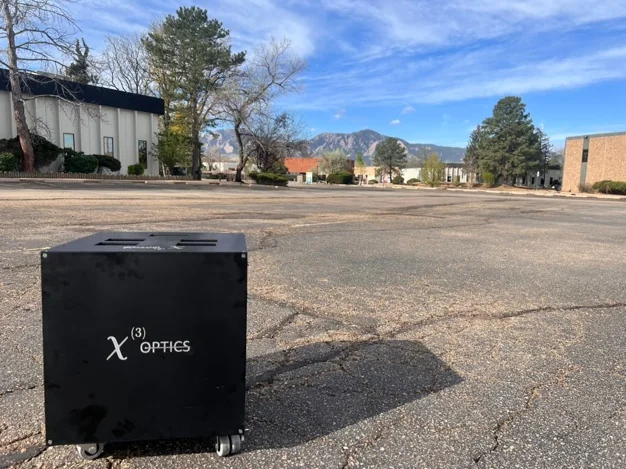
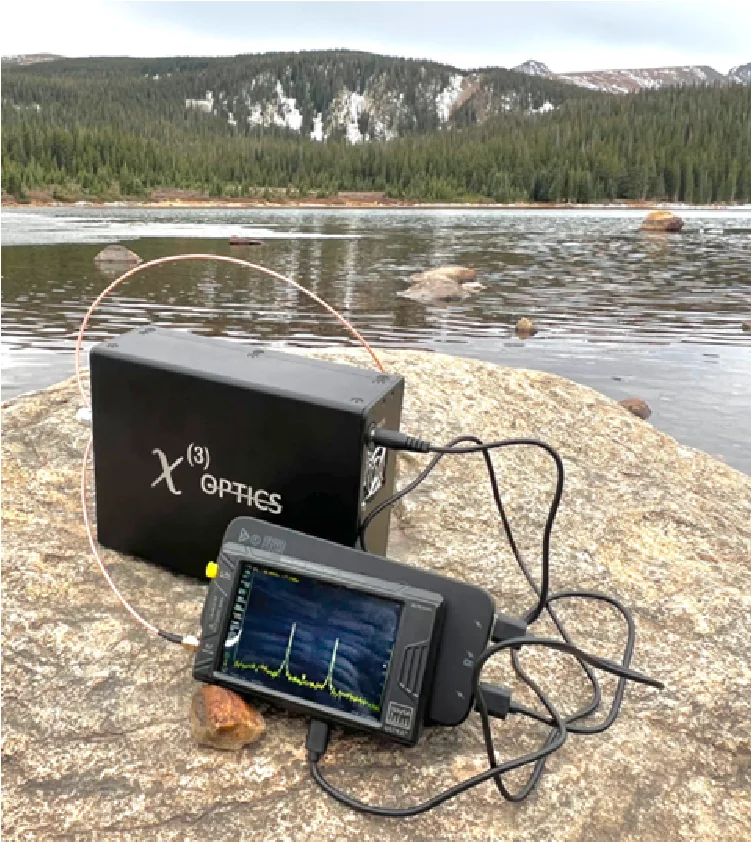
Our low-SWaP combs run on batteries, keep phase lock under high-vibration testing and have been operated in mountain environments and on open outdoor paths — bringing metrology-grade light to where the measurement actually is.

  • Battery-powered portable operation
  • Phase locking maintained under vibration
  • Open-path mid-IR dual-comb spectroscopy
  • Turnkey: one button, one engineer
Portable frequency comb operating outdoors by a mountain lake Mid-IR dual-comb system deployed outdoors

Technology

From fiber to chip

Optical frequency combs went from full optical benches to rack-mount units. We are taking the next step: the same comb performance, printed at wafer scale.

χ(3)

Our name is the third-order nonlinear susceptibility — the physics behind everything we build. We engineer nonlinear optics across twelve orders of magnitude in pulse energy, from femtojoules to millijoules, choosing the platform that fits each energy scale.

Nonlinear and coherent. Nonlinear optics creates new colors; coherence makes them useful. Every stage we design — harmonic generation, dispersive waves, difference-frequency generation — is chosen to preserve the phase of the comb, so new wavelengths remain a frequency comb that can be locked, referenced and counted.
fJ – pJNanophotonic waveguides

Thin-film LiNbO₃ and SiN chips: on-chip SHG in periodically poled LiNbO₃ (e.g. 1560 → 780 nm), cascaded χ(2) + χ(3) harmonics and supercontinuum, and mid-IR generation on LiNbO₃-on-sapphire — at the lowest energies, on a wafer.

pJ – µJFiber

Highly nonlinear fibers and amplifiers: solitons, dispersive waves, supercontinuum.

µJ – mJSolid state & gas

Bulk crystals, gas-filled hollow-core fibers and capillaries, and multipass cells for high-energy compression and VUV–UV conversion.

Fiber frequency comb system Generation I · Now

Fiber combs

Mode-locked Er:fiber lasers with spectral broadening in highly nonlinear fiber — our current commercial products.
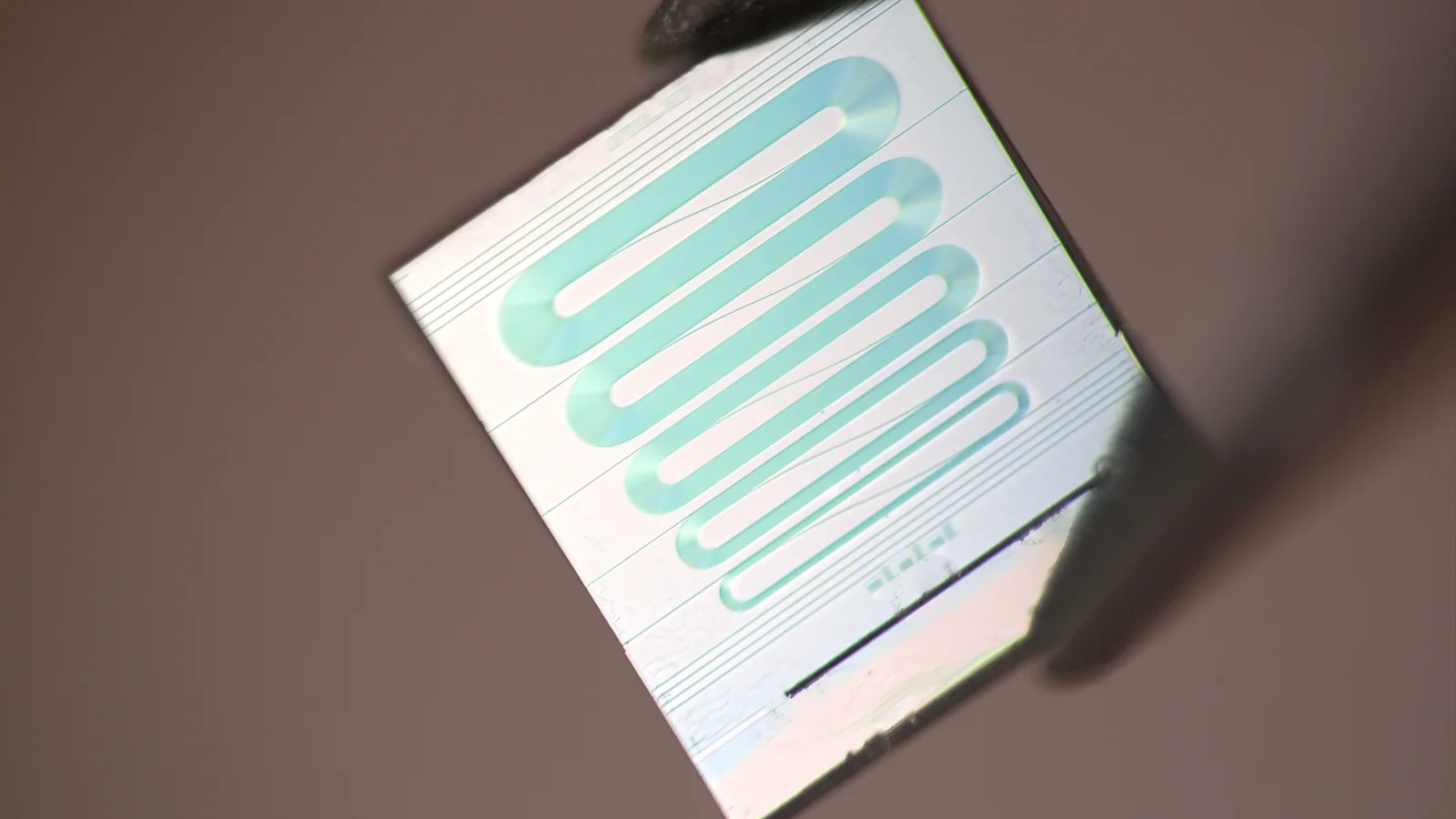
Thin-film lithium niobate waveguide chip Generation II · In development

Fiber + TFLN

Fiber mode-locked lasers with spectral broadening in thin-film lithium niobate nanophotonic waveguides.
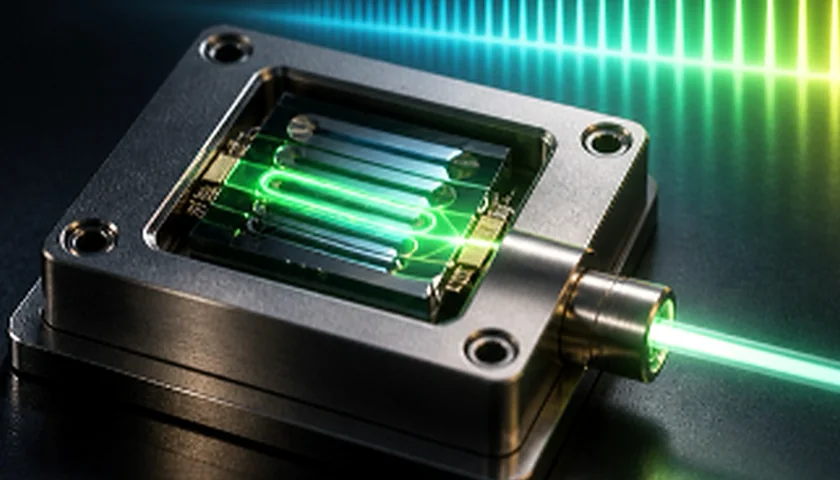
Comb on chip: packaged photonic chip, concept render Generation III · Next

Comb on chip

Mode-locked laser and spectral broadening fully on-chip, lithographically printed hundreds at a time on 8-inch wafers.

Nonlinear photonics

Designed in simulation, proven in the lab

Every source we build starts in simulation. Our in-house models solve the full nonlinear propagation of ultrashort pulses — χ(2) and χ(3), in fiber, gas, nanophotonic chips and bulk crystals, from femtojoules to millijoules — together with mode solving, dispersion engineering and quantum noise. We know where the light will go, and whether it stays coherent, before we build it.
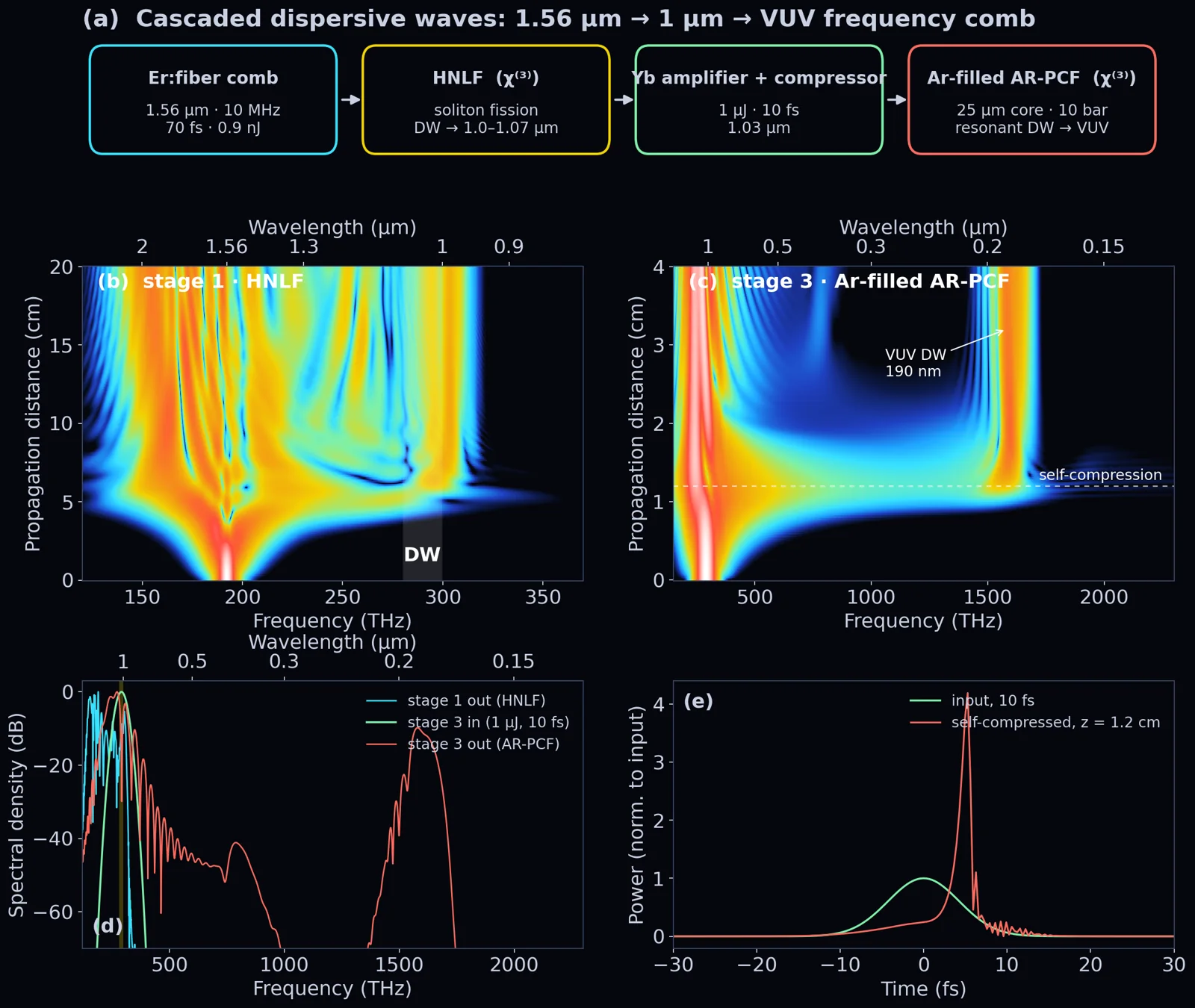
Er:fiber comb1.56 µm · 10 MHz · 70 fs
HNLF · χ(3)soliton fission → DW 1.0–1.07 µm
Yb amp + compressor1 µJ · 10 fs · 1.03 µm
Ar-filled AR-PCF · χ(3)resonant DW → 190 nm VUV
Simulated cascaded dispersive-wave generation from 1.56 µm to the VUV
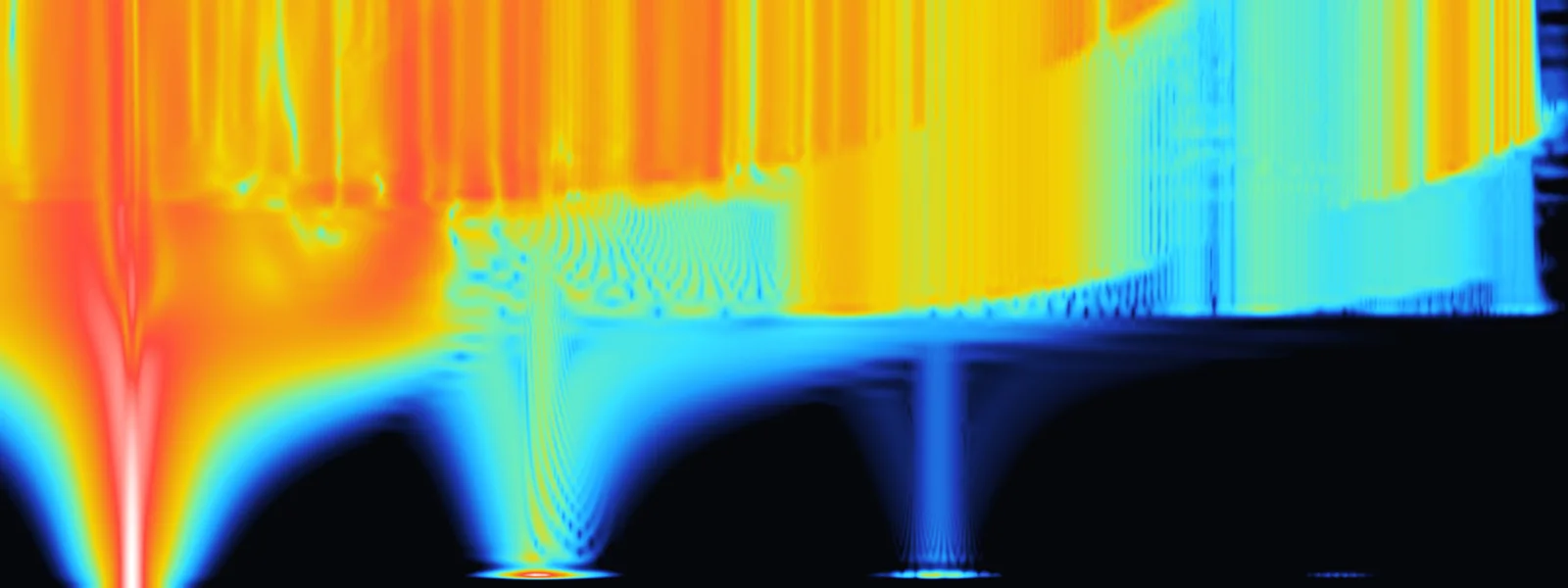
Cascaded dispersive waves: from a 1.56 µm comb to a VUV frequency comb. A 10 MHz Er:fiber comb launches a dispersive wave at 1.0–1.07 µm in highly nonlinear fiber; after Yb amplification to 1 µJ and compression to 10 fs, soliton self-compression in an Ar-filled anti-resonant hollow-core fiber (25 µm core, 10 bar) emits a second, resonant dispersive wave at ~190 nm carrying ~12 % of the pulse energy. Both steps are coherent χ(3) processes, so the comb structure is carried from the near-IR to the vacuum ultraviolet. GNLSE simulation; stage 2 assumed. Full figure →
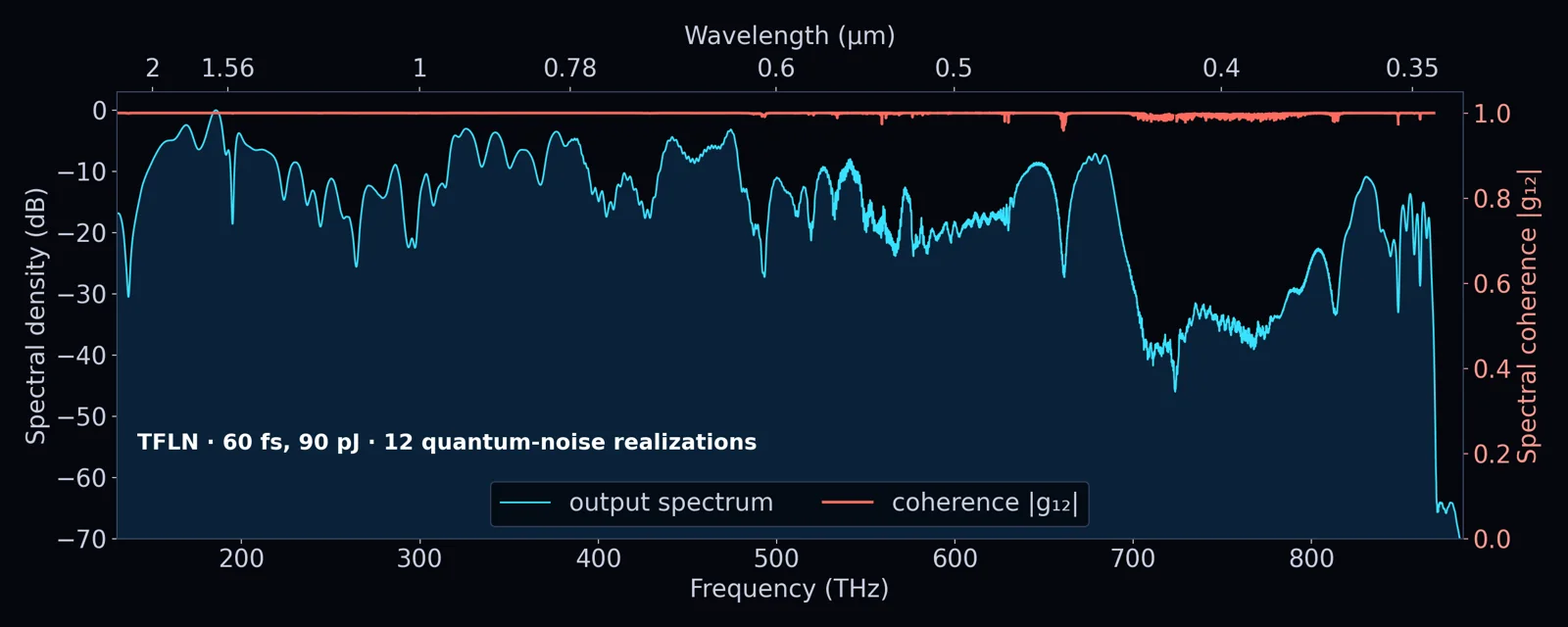
Simulated spectral coherence of the thin-film lithium niobate visible-UV comb
Coherence by design: a frequency comb all the way to 350 nm. First-order spectral coherence |g12| of the thin-film LiNbO₃ visible–UV comb (60 fs, 90 pJ), computed from 12 independent quantum-noise realizations of the full χ(2) + χ(3) propagation. |g12| stays at ≈ 1 across the entire spectrum and above 0.98 throughout 350–550 nm: the new colors keep the phase of the 1.56 µm comb, so they can be locked, referenced and counted.
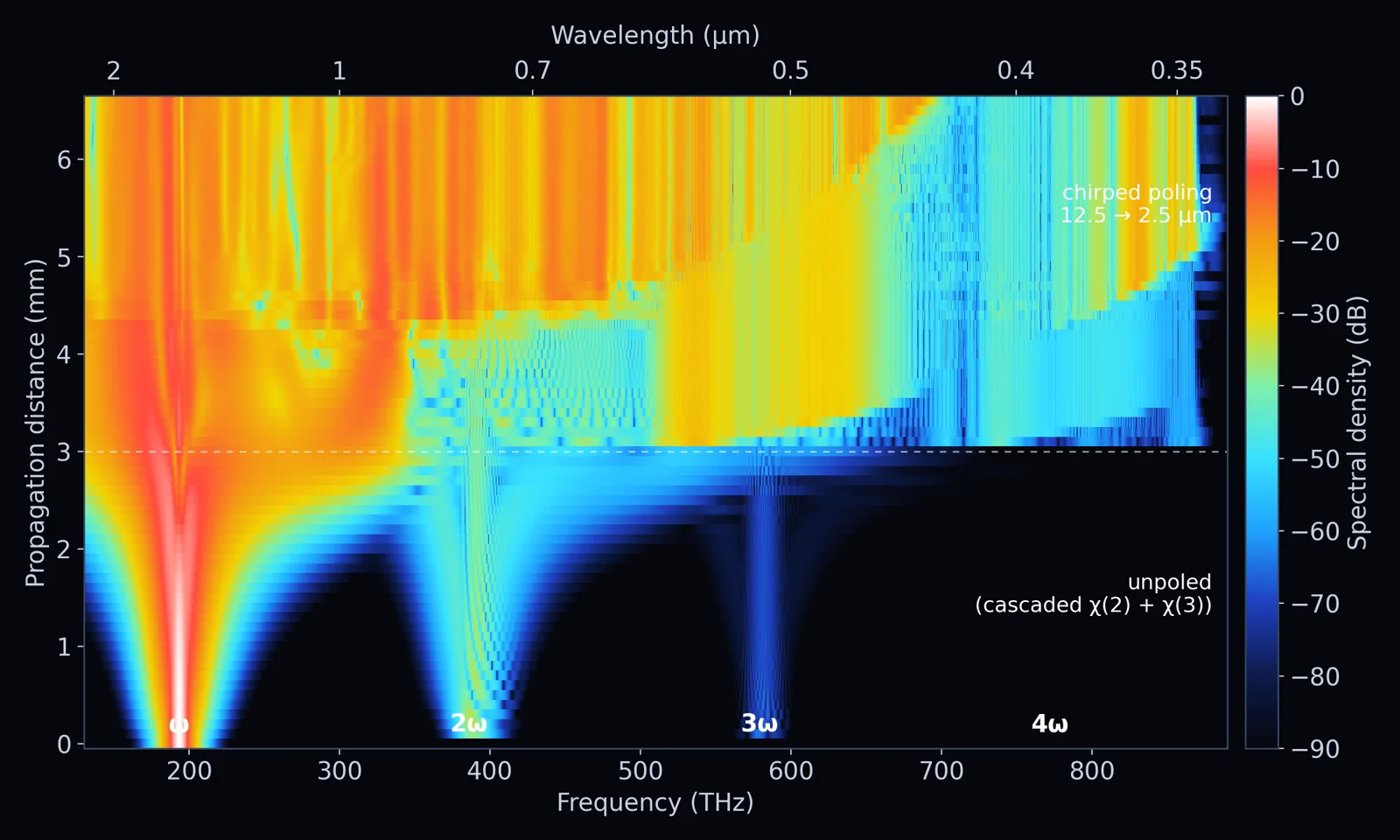
Simulated cascaded chi(2) harmonic generation in a TFLN waveguide
Cascaded χ(2): from one color to a gap-free UV–visible comb. A 1560 nm, 60 fs pulse first generates 2ω, 3ω and 4ω harmonics in an unpoled thin-film LiNbO₃ waveguide; a chirped poling section then merges them into a continuous spectrum reaching 350 nm. Model of the device in Wu et al., Nat. Photon. 18, 218 (2024).
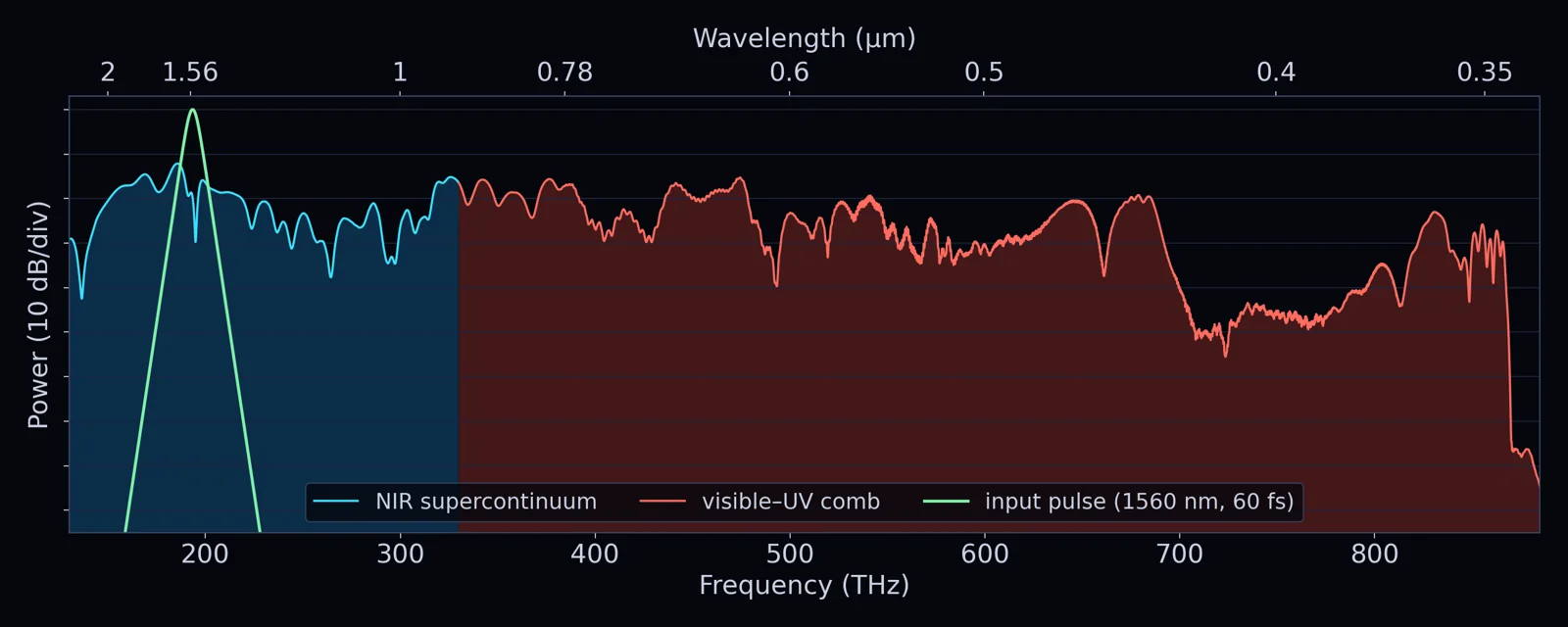
Simulated output spectrum spanning 2 µm to 350 nm
Output spectrum: 1.56 µm in, 2 µm – 350 nm out. The same simulation at the waveguide output (10 dB/div): a single 60 fs pulse becomes a near-infrared supercontinuum (blue) and a coherent visible–UV comb (red).
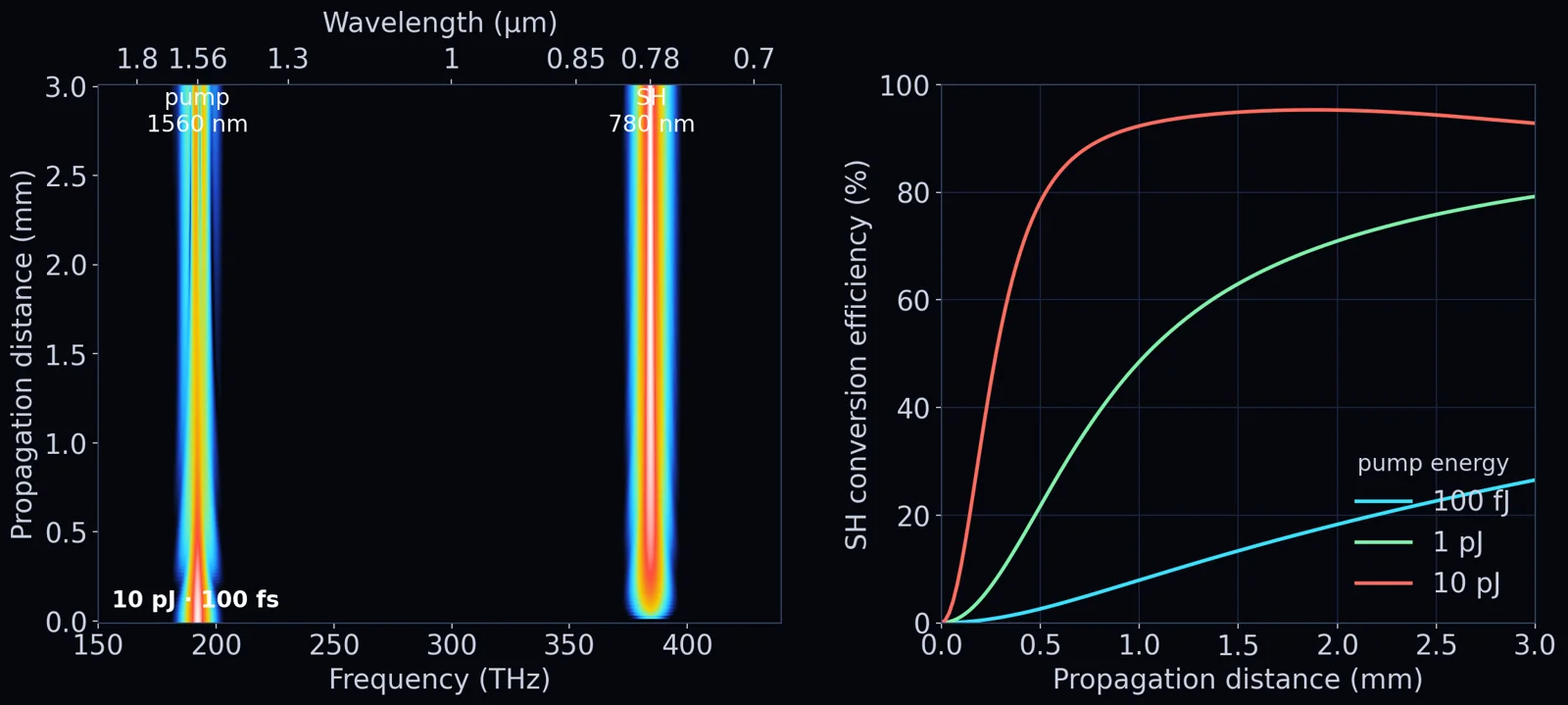
Simulated on-chip second-harmonic generation in periodically poled thin-film lithium niobate
On-chip SHG at the femtojoule scale. 1560 → 780 nm second-harmonic generation in a periodically poled thin-film LiNbO₃ ridge (100 fs pump, 3 mm): 27 % conversion from a 100 fJ pulse, 79 % at 1 pJ and saturation above 95 % at 10 pJ — a 780 nm source for rubidium-based quantum systems that fits on a chip. UPPE simulation (χ(2) + χ(3)).
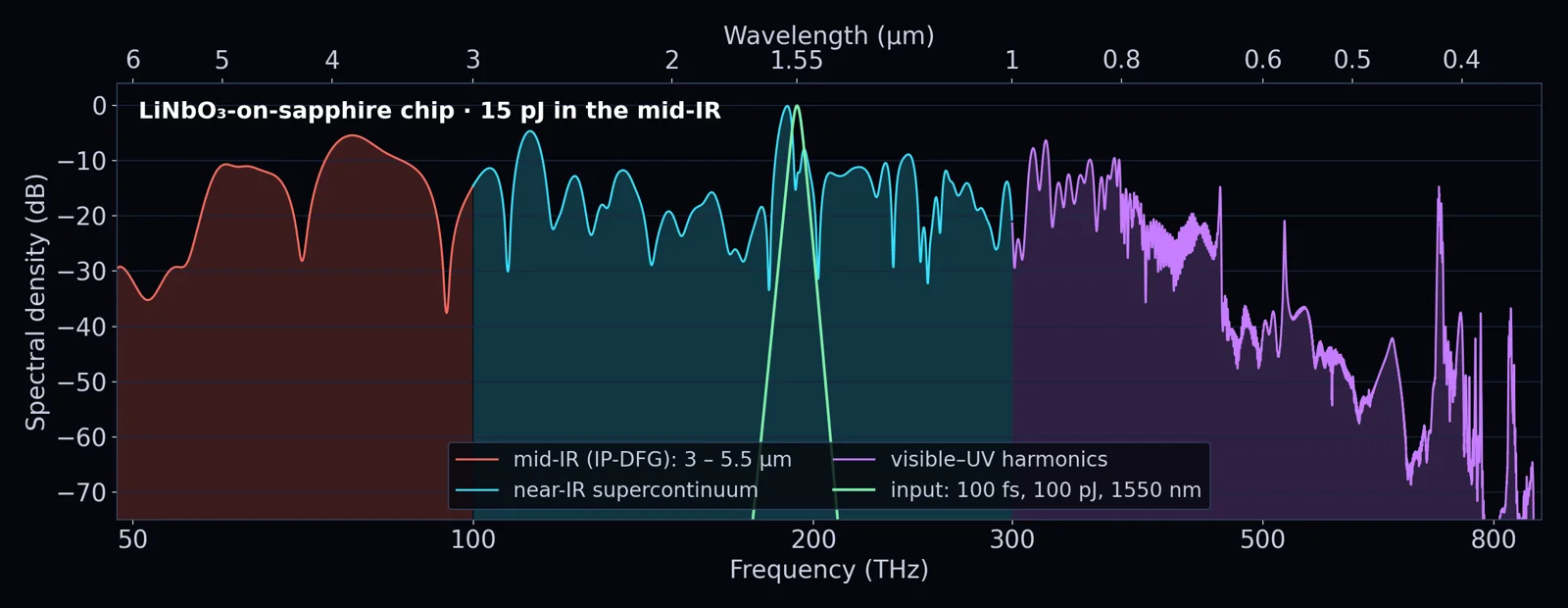
Simulated UV to mid-infrared spectrum from a lithium-niobate-on-sapphire chip
Mid-IR on chip: LiNbO₃ on sapphire. Replacing the silica under-cladding with sapphire keeps the mode guided and transparent beyond 3 µm. A 100 fs, 100 pJ, 1550 nm pulse is broadened and compressed in a first poled section, then intrapulse difference-frequency generation in a chirped second section delivers ~15 pJ across 3–5.5 µm — while the same chip also emits visible–UV harmonics. One chip, 0.35–6 µm. UPPE simulation.
Simulated waveguide modes at the pump and its harmonics
Waveguide modes at ω, 2ω, 3ω and 4ω. Finite-difference mode solutions of the 710 nm x-cut LiNbO₃ ridge (1.8 µm top width, 360 nm slab): tight confinement at every harmonic keeps the nonlinear interaction strong across the octave.
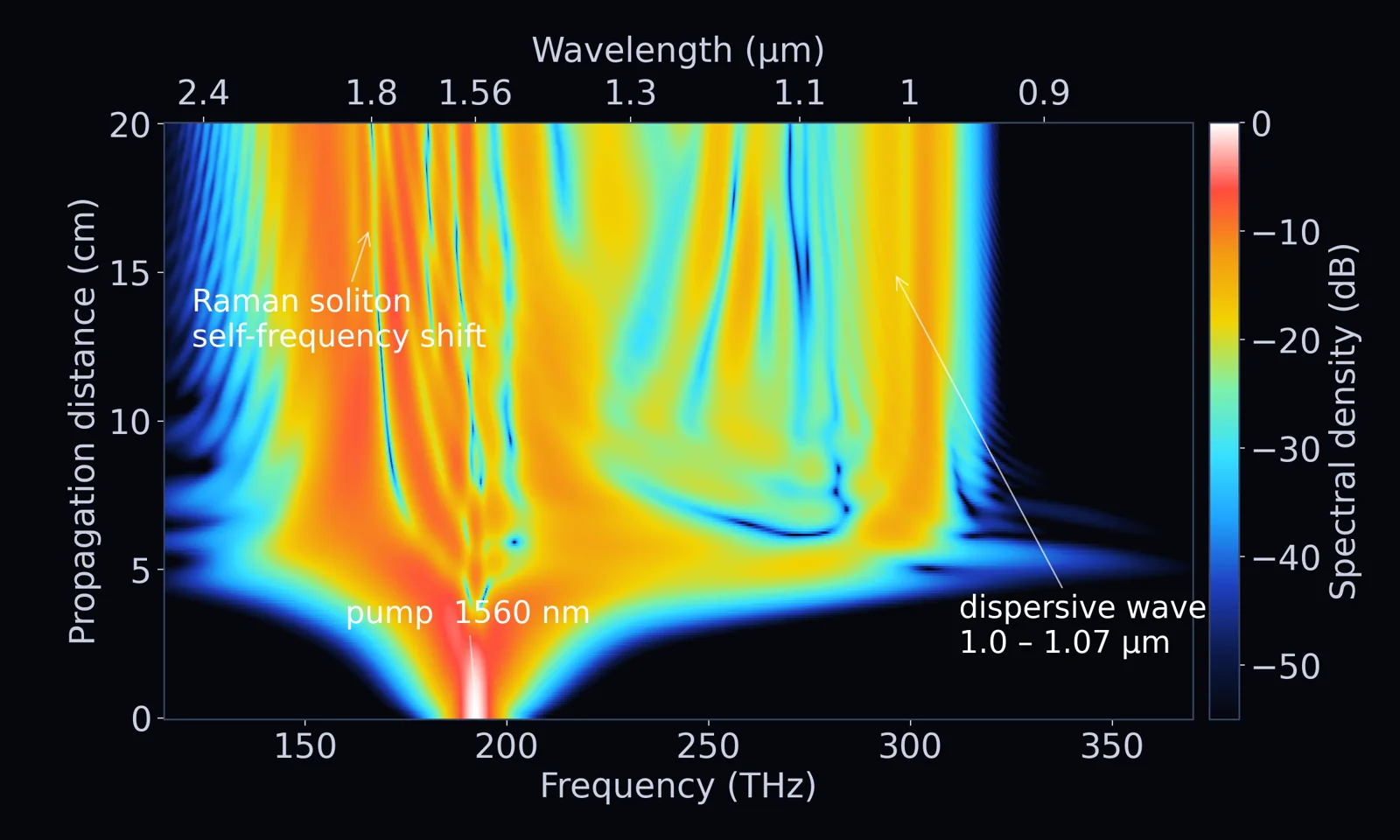
Simulated dispersive-wave generation, spectral evolution
χ(3) dispersive wave — spectrum. Soliton fission of a 70 fs, 1560 nm pulse in highly nonlinear fiber seeds a phase-matched dispersive wave at 1.0–1.07 µm while the Raman soliton shifts beyond 1.8 µm.
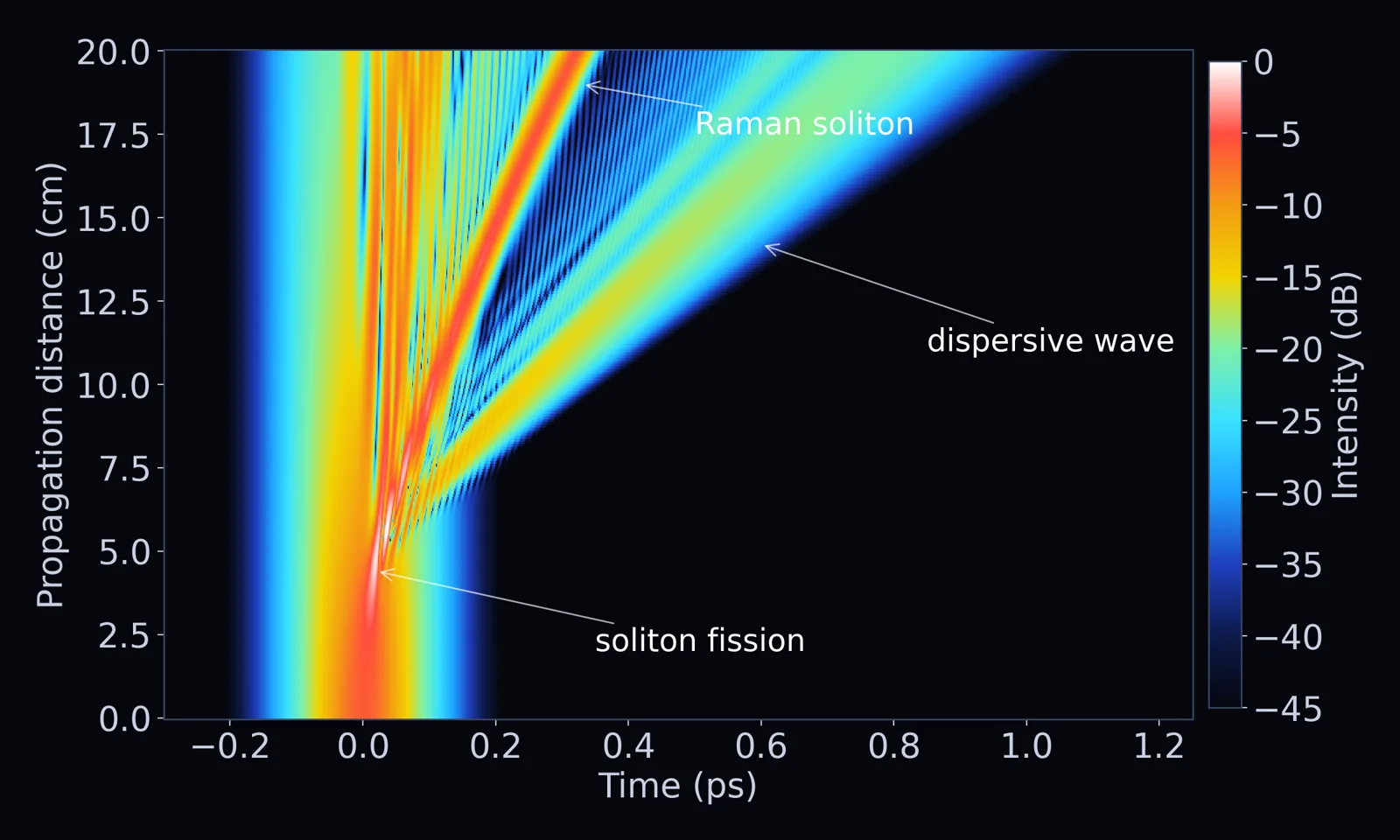
Simulated dispersive-wave generation, time domain
χ(3) dispersive wave — time domain. The same evolution in time: the input pulse compresses, fissions, and sheds the dispersive wave, which walks off from the Raman soliton.

Applications

Light for precision measurement

Quantum technologies

Stable optical references and multi-wavelength combs for trapped-ion and neutral-atom platforms, including direct 780 nm light for rubidium.

Dual-comb spectroscopy & gas sensing

Broadband, high-resolution and fast trace-gas detection from the near- to the mid-infrared, in the lab or along open outdoor paths.

Semiconductor metrology

Non-contact, real-time optical measurement of films, stacks and process chambers.

Precision timing & microwave photonics

Low-noise optical-to-microwave links for timing distribution, radar and navigation.

Nonlinear & ultrafast science

Watt-level femtosecond pulses for supercontinuum, mid-IR and UV generation.

Field deployment

Low-SWaP, battery-powered combs that keep lock outdoors, in the mountains and under vibration.

About

Built by frequency-comb scientists

Chi3 is named after χ(3), the third-order optical nonlinearity. We build nonlinear light sources from femtojoules to millijoules — in nanophotonic waveguides, in fiber, and in solid-state and gas-phase optics.

Chi3 Optics combines lean manufacturing with advanced optical techniques to produce ultra-low-phase-noise, high-power lasers at competitive prices. Our team brings a cumulative 50+ years of experience with frequency combs and laser science, and our technology builds on intellectual property licensed from the University of Colorado.

We design, package and test every system in Boulder, Colorado, so every unit arrives compact, turnkey and ready for high-precision work.

Tsung-Han Wu, Ph.D.

Tsung-Han Wu, Ph.D.

Founder & CEO

Nathan Brooks, Ph.D.

Nathan Brooks, Ph.D.

Principal Scientist

Prof. Scott Diddams

Prof. Scott Diddams

Scientific Advisor

High precision. Compact. Turnkey.

Frequency combs, ultrafast lasers and amplifiers ready for the lab and the field.

Request a quote